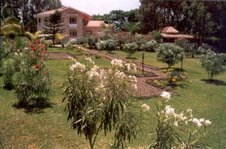
Well, I did it. And I have a certificate to prove it. I climbed a mountain to visit Aigosha and his family. And we had a very charming visit with this gorilla family. If you haven't guessed by now, I am in Rwanda. They say that visiting the mountain gorillas is a once in a lifetime experience that one shouldn't miss. I was skeptical last night and early this morning, but now that it is over, I agree.
I arrived in Rwanda on Friday night and spent the first day touring the city and talking about the genocide with my charming guide, David. David was born in a refugee camp in Uganda where his family fled during a violent period shortly after independence. He had pretty grueling experiences to share and clarified a lot for me about this 1994 genocide. More on all of that later.
In the late afternoon, we headed up to the Virungu Volcanic Park which was a sumptuous drive through continuous mountains, every inch of which seems to be cultivated. The roads are pretty crowded, and David drove the route constantly blurting out "Hopeless" as his country men and women wove in and out of traffic, and dashed across the street in front of us. It was a three hour drive and after a quick dinner we headed for bed because we had to get up at 5:30 to get started on the gorilla trek. I was not particularly keen on this gorilla trip but everyone in Tanzania said it was a must, so I signed up. Truthfully, I had been dreading it. I looked at it as a pennence to for the lovely ride I had had up to the park.
My heart sank this morning at 4:45 when a fierce rain storm woke me up. I did buy a rain slicker and gaiters to protect me against the elements, but I was not looking forward to hiking up a volcano in the rain. But luck was with me as it stopped raining just as we began our climb (there were eight of us in Aygasha's group. | was cheered to see an elderly couple in our group and I, of course, hung out behind them the whole trip. That way I gave the appearance of being a caring, rather than an out of shape, hiker.
The hiking goes like this: Trackers start out early in the morning to find the gorilla group you are looking for and once they locate them, they send information down to the guides. When we started out they told us that it would be a half an hour hike, and I was secretly overjoyed. Problem is gorillas don't always stay in one place and our little group did quite a bit of flinting around before we found them.
Now, when I say hiking, you need to understand that there are really no trails here. Sometimes we followed gorilla trails, but most of the time, we forged out own path through the thick, thick, thick rain forest. It was hideously muddy; in fact, at one point, I stepped in mud that reached me knee and when I tried to pull my foot out, my shoe and gaiters remained stuck. The porter kindly dug out my equipment, cheerfully washed it off in a mud puddle and had me back on the way in minutes. So we walked and crawled through the thick vegetation for nearly two hours. Just when we thought we were close, they moved (they were foraging for food) and at the point where I said I can't do this anymore, the gorillas appeared before us. Aigasha was with three females and a couple of kids. He humored us by staring at us and scratching a bit and then he took a nap. Wife number one groomed one of the kids for a while and then she took a nap. Eventually they all took a nap, except for the little babies who played together and alone the whole hour (visitors are only allowed one hour with the gorillas). There much more to tell about this amazing adventure and I have lots of video to show interested parties, but I don't have much time left on this computer.
Here is an item that might surprise you; it really surprised and dismayed me: There are no ATMs in Rwanda. I can't get any money out of the bank and I owe the tour company that I came with beaucoup de money (This,by the way, is an excellent tour company that focuses on educational visits, including volunteer work...more on that later). I hope I can work something out when I get back to Kigali tomorrow. Monday is figuring out the money day and then I spend Tuesday with Women for Women International, and then I am off to Morocco to see my beloved husband, with a short stop in Amsterdam.
More later from Kigali. Forgive the misspellings!
Sunday, October 21, 2007


Wednesday, October 17, 2007
A Tanzanian Wedding
On the weekend a friend of mine who runs an NGO (WEECE)that supports women who operate businesses invited me and a friend from CCS to attend a wedding of the daughter of one of her members. The wedding was a Christian wedding although the bride was Muslim (we assumed that she converted). We only attended the reception as those Christian ceremonies can be quite lengthy, but we had a great time because there was an action-packed agenda and plenty of beer and spirits flowing. It was quite a boisterous affair too, with lots and lots of dancing.
First the wedding car arrived at the hall (YMCA) and the family members of both the bridge and groom danced around the car for awhile while the rest of us watched and swayed with the music. Then we left the car and headed into the hall. A half an hour later the groom's family got up singing and trilling as the raced down the aisle to welcome the bride and groom and then they proceeded to sing and dance as they escorted the couple all the way back to the front of the hall. When the bride and groom were comfortably ensconced at their table in the front of the fall, it was our turn to get up and dance to welcome them, which we did enthusiastically. Later each member of the groom's family was introduced to us and after that was done, they all got up and danced. Then the bride's family was introduced and then they danced for a bit.
Later the traditional African Cake (a roasted goat) was brought in by a large group of cooks who, of course, danced down the aisle to the front of the room swinging the poor goat to and fro with great pride and exuberance. Later, there was a sweet cake cutting ceremony and then lots of good food. After we ate, we guests formed a conga line as we danced down the aisle carrying our gifts to present to the bridge and groom. As I was the only Mzungu dancing, I imagine they were a little surprised when I appeared before them, but they masked it very well and were quite gracious when I shook hands and congratulated them. Unfortunately we have an 11:00 curfew at the home base, so we had to leave early and missed the partying part of the party.
This was considered a small wedding as there were only about 300 people in attendance, but the hall was quite elaborately decorated with bushels of roses and yards of streamers and bunches of balloons. Typically the families will take a few months to fund raise for a wedding (I'm not sure which family has this responsibility) by soliciting monetary gifts from their extended family members to help pay for the festivities because except for the wealthy, most people here cannot afford to put on such a celebration on their own.
Monday, October 15, 2007
Last days in Tanzania
I have only four more days here in Tanzania. It seems impossible that I have been here for two months already. Saddly, I have so much to do in these four days that I am sure they will zoom by at neck-breaking speed. So I thought I might spend some time reflecting on my experiences here in the next few posts.
Things that I will miss include:
The wonderfully friendly and extremely polite and sympathetic Tanzanians. I have made many friends here and many acquaintances whose company I have thoroughly enjoyed and will sorely miss.
My fellow teachers at St. Theresia Secondary school and the many fascinating hours we have spent together discussing teaching, Tanzania, religion (too much of this topic for my tastes) the U.S, and life in general. This has truly been an invaluable cross cultural experience for us all.
My lovely students who sometimes, I admit, have made me a little crazy. I know I have shocked them on more than one occasion with my ideas and teaching style, but they have been wonderfully welcoming and open. You will see them at a screening of the movie that the llth graders and I are making and see why I have been so charmed by them.
I will also miss the head massages I get from my students when I sit down with them to do group work or do some filming. On these occasions, there are always three or four hands in my hair kneading, twisting, braiding, exploring this new texture.
The sights and sounds of Tanzania, including the beautiful kangas and kitenges the women wear, the call to prayer and church bells, gospel music and Tanzanian hip hop called Bongoi Flava, seeping from cars and doorways, and the rich smell of fresh fruit and vegetables, and occasionally Indian spices.
The children you meet on the roads who sweetly smile and greet you with "Good morning, Teacher. How are you? I am fine!" all in one breath. This, as much in the afternoon and evening as in the morning. The children here are so delighted to meet foreigners, maybe because we look so odd or because we are novelties here (there aren't many Mzungus in this area). They run along side the cars and vans waving gleefully, yelling "Hello!!" or "goodbye!!". Of course, we always worry they might fall and get hit, so we wave and smile but also yell, "Acha, acha" which I think means get back from the car.
Things I won't miss:
The horrible roads, full of boulders and gullies and gigantic craters. So bad that if you don't hold on to the seat in front you will be tossed off your seat entirely.
The decrepit daladalas that are so packed with people you can barely breathe. Actually, I don't really mind the daladalas that much, it's just that yesterday I rode two that about killed me. On the first, I was one of the people who couldn't get a seat so I had to stand up hunched over another person, folded at the waist. If she had turned her face toward me I would have had to kiss her we were so close. Then another poor soul got on and also had to stand stooped over right next to me. At one point as I mumbled something to myself about the deplorable situation I found myself in, he said "This is Tanzania" When I told him they needed to get more daladalas on the road here in Tanzania, he simply assured me that "It will end eventually" which did not console me in the least. When the daladala stopped again, I thought to myself, "Please God, let someone get off" and instead another person got on and I found myself perched on one leg with an even more contorted posture, I said "okay, this is enough. Let me off!!" I'm sure the people in the daladala thought that I was a silly, soft Mzungu, but I don't care.
On the second ride I at least got a seat, but was only able to half sit on it as there were many people sharing the two available seats with me. We were so squashed in at one point that a fight broke out between two women, forcing me to take two children on my lap so as to avoid fisticuffs. It was sweltering hot and the gears on the van crunched horribly; I couln't imagine how we could make it to our destination, but of course we did, and I felt that I had regained some of my pride among daladala rider.
Later, I was advised not to get on a daladala if I can't get one of the front seats. Sage advice which I will follow assiduously.
I think those are the two things I won't miss here.
No wait, the horrible lack of resources for schools should be on the top of this list. The dearth of books, pens and pencils, rulars, paper, chalk, electricity that children and teachers must endure.
More later
Thursday, October 11, 2007
International Criminal Tribunal for Rwanda
Yesterday I had the opportunity to sit in on a hearing at the ICTR. The ICTR has four courts and they all have been on recess since I have been in Tanzania. Fortunately, all four trials resumed this week. The ICTR has completed 66 or so cases since its inception in the mid nineties. There are 18 current defendants. Most of the accused have been convicted and are serving prison terms; a few have been acquitted. This tribunal only hears cases against those who were in positions of leadership and authority in Rwanda at the time of the genocide. There are 8 more cases pending trial and the ICTR is supposed to close in 2008, but at the pace these trials are proceeding, I doubt they will make it.
The case we heard yesterday has been in session for four years. The accused are four men who were ministers in the transitional government in 1994 after the Rwandan president's plane was shot down. The person who was testifying (in his own defence) had been the minister of foreign affairs. The ministers of health, trade, and something else were his co-defendants. The courtroom is quite full as there are three judges who sit in the middle of the room, with assistants and court reporters around. Facing the judges, but with his back to the spectators sits the witness. There is a curtain that can conceal the witness in cases where witnesses must be protected. This witness/defendant was in full view of the spectators' section. Then there is a small army of prosecuting attorneys on the right and another small army of defense attorneys on the left, along with the other accused.
The attorney conducting the cross examination was an African-Canadian with a wry and satirical sense of humour who had the court guffawing on a number of occasions; however, his examination of the defendant was devastatingly serious and composed of two parts. First he establish (successfully) that the minister indeed was in a position of power at the time to stop the genocide, and then he focused on a speech the minister had given to the security council in early May 1994. It took about two hours to get all the information on the table because it is an extremely laborious process to conduct an international trial in three languages; there was a lot of paper shuffling so that everyone in the court were on the same page, etc.
We were all appalled when we finally heard the full contents of his speech, which included absolutely nothing about Tutsies being massacred, and created the impression that it was the Hutus who had been under attack by the Rwandan Liberation Front (can't remember exactly the the name of this group). Now, indeed, the RLF had been responsible for killing some Hutus somewhere in the country, at some time, but this speech, delivered 5 weeks after the genocide had started, completely covered up what was really going on in Rwanda. When he was questioned about not mentioning the Tutsi massacres, he stated that he had said "Hutus and others." it was realy unbelievable.
I think this guy is doomed and I hope he rots in prison for the rest of his life. There is a prison at the ICTR site where all of the accused live for the duration of their trials, and I read in the paper last night that prisoners there are all on a hunger strike now because there is talk of moving the final eight trials to Rwanda. They worry of course about getting a fair trial there.
It was quite moving to attend this trial and to see that these gross violations of human rights will not go unpunished.
Sunday, October 7, 2007
A visit to the Big Town
As much as I like our little Moshi Town (population 5,000), I am often frustrated by the limitations it has in terms of resources/goods. This weekend I went the Arusha which is an hours drive from here to solve my resource problems. Arusha is the third largest city in Tanzania (300,000 population) and it feels like a bustling metropolis. This town, in fact, features large in East African politics. It's the seat of the East African Community and the UN Rwandan Tribunal and the place the politicians in the region meet to discuss current events/policies/issues (things like refugee crises, what to do about Mungabe and Somalia, etc.)
My goal in going to Arusha this weekend was to shop. And I was quite successful. A friend contacted one of his homeboys in Arusha to assist me on my shopping spree and we got it all done in about three hours. Here's what I bought: a classroom pencil sharpener, a rain slicker and gaiters (things you put on your pants to protect your clothing from rain, mud and prickly things on a trek) music cds (and I got a Tanzanian movie too while I was there), reading glasses (I had left mine in Moshi) and the big score - a mini microphone for my video camera (This I found on my own after visiting 8 electronic shops in Arusha). None of the above items are available in Moshi so I was extrmeley pleased with myself all day today.
I also got more batiks from the street vendors who were so grateful for my purchases that a group of them (stationed outside of my hotel) accompanied me on all my excursions in the afternoon. My friend booked the hotel for me and I was slightly alarmed when he told me it was $20 a night, but he assured me that it was a good hotel and it was! The restaurant had good food and was a good hangout in the evenings, the rooms were basic but clean and there was a TV (I watched Nigerian soap operas at night) and a telephone from which you could not make outside calls (!).
Sunday morning I got up and took a daladala home - always an intriguing, somewhat alarming experience for $1.50. On Friday my friend John drove me to Arusha because he wanted to show me the orphanage he is building half way to Arusha. He is a small-time tour operator who sinks most of his profits into this orphanage. The orphanage is in his home village which is at the foot of Mt. Meru, the second largest mountain after Mt. Kili, so it's cool there but with tropical vegetation. After seeing the orphanage we spent some time with his family who live sort of next door. It was a great excursion. There was a tiny calf (two weeks old) at his father's farm who delighted everyone with her antics, the favorite of which was playing tag with the roosters. Who knew farm life would be so entertaining.
Now I am home in Moshi, getting ready for work tomorrow. I have only two weeks left in Tanzania and I am already starting to feel meloncholy about leaving.
Thursday, October 4, 2007
More on Teaching in Tanzania
Somethings are the same everywhere. Last week as students lined up to file into the classroom for a test, they were required to roll up their sleeves, pull out their pockets, and open their pencil cases (for the few who have such things)so that the supervising teacher could make sure they hadn't prepared any testing aides. I remember doing that at Mission High school where I worked as a teacher's assistant many, many moons ago.
It's always a challenge to prepare lessons when you are limited to a chalkboard for the most part, but there are other frustrations of teaching in Tanzania as well. Students, for one, are not used to our interactive, communicative methodology. They primarily learn English through rote memorization and grammar drills, so when I put them in groups or pairs to brainstorm a topic, discuss an issue, or analyze a reading, they are confused about what is required of them. This lack of preparedness or independence impacts their ability to perform on the national exams they have to take, so it's not surprising that only about 28% (according to an article I read in the newspaper) earn high enough scores to continue their educations. I graded the papers of Form 2 students who take national exams at the end of october and was floored to see that only about 5 our of 42 passed the grammar portion of the exam.
Then there is the annoying practice of students standing up whenever they answer or ask a question. When I do quick questions to practice a grammar point, students are constantly popping up and down to participate. I want to tell them to sit through the exercise, but worry that the faculty will complain that we spoil the students and not invite mzungu volunteers back.
The class schedule has been Really flexible for the past two weeks, and so we haven't taught much as classes were cancelled first for working in the shamba picking corn, then for preparing the school for their first graduation, then two of the levels went home for a week to collect their school fees for next year, and they have trickled back this week, so we have had about half of the students in class this week. I only have two more weeks here, so I anxious about getting things done. One class and I are making a movie of St. Theresia which Nick and I and one other person will use to recruit pen pals for students in the first three forms. I have been staying late to work on this project with them, but it has actually been a lot of fun. This week they are writing scripts and figuring out what photos and video footage and music they need and we will start filming next week. I'll put together the movie when I get to Morocco, which is in three weeks I think!!!
Wednesday, October 3, 2007
Mob justice
Yesterday my fellow volunteer and colleague at St. Theresia rode the daladala home and was relieved of his wallet as he was getting off the maniacally crowded van. When he alerted the other passengers to the theft one of them pointed to a man in a blue cap who had gotten off the bus with Nick. The man ducked into a house in an alley and a crowd ran after him. Minutes later they dragged him kicking and screaming back to the daladala, reached into his pockets and returned Nick's wallet. The man then tried to get back on the daladala, but a now very large crowd managed to pull him off the bus as he desperately clung to a railing. Then one in the crowd picked up a very large rock and slammed into into the thief's head. A crowd of about thirty surrounded him and proceeded to beat him. Nick, alarmed, begged people to leave the thief alone, but a few in the crowd advised Nick to leave them alone and go home. Which he did.
We have been told horror stories such as this by numerous people. Typically, we are told, a furious crowd will throw a tire around a robber and burn him alive. This happens at least once a week in Dar es Salaam, according to my colleagues at St. Theresia. Everyone we talk to here says that thieves spend one or two days in jail and then are let free, so people feel they have to take matters into their own hands. It's unfortunate, but it teaches a lesson, they say. This is only done, they assure us, when it is 100% clear that the person they are planning to burn is indeed guilty. From my civics book, I know that such acts are illegal here, but I doubt that people are arrested or prosecuted for such crimes. It's unnerving to even think about, much less witness. Rick was quite shaken up by the experience.
My guess is that people resort to this behavior out of extreme frustration. Life is hard here and people work very hard to meet the basic necessities of life. They have to save up for things like cell phones and head sets (two items two colleagues lost to thieves recently) and are enraged when things are taken from them.
At the same time corporal punishment is fairly widespread here. Children receive thrashings at school, not much fuss is made of domestic violence, and prisoners receive a certain number of canings along with their sentence for crimes committed.
In school, teachers are very stern and strict with students. They even take switches to class with them. It's no surprise then that students are very quiet and serious in class. This initially drove me crazy. My teaching style is informal and relaxed and I like to joke a lot with students and tease them to set them at ease. They have a hard time figuring out how to relate to me, and Nick too, for that matter. But we are slowly getting used to each other. The other day, I handed Nick a switch and suggested we bring them to class to throw the students off. The faculty burst out laughing at the absurdity of a Mzungu using a switch on students. I didn't do it yet, but I will just for fun one of these days. They actually would work quite well as pointers.
Subscribe to:
Posts (Atom)