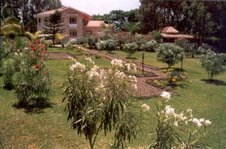
I could live in Amsterdam... easily. It's beautiful, cultured, cafe's are ubiquitous and so are the coffee shops for that matter (that's where you can buy weed and other drugs... not that I have visited one), and you can get on quite well with English here. Then there is the socialized medicine and humane euthanasia practices too.
I read a an article by someone of the police force in a tourist magazine in which the writer offered tips on how recover if one takes too much weed or what they call here "smart" drugs (LSD, mushroom, etc.). The advice was to drink lots of water and eat sweet things.
Oddly enough, with all the cycles out and about, no one wears helmets. Many people ride with their babies and toddlers on the front and back seats...all of course without helmets. A cab driver said that the Dutch cyclists don't have accidents, only the foreigners do. Of course their are great cyclist lanes too.
I have been walking around enjoying the architecture and shops and buying supplies for my teaching gig in TZ. My big coup was a functioning CD player for 6 Euros that I got at a flea market. I haven't found any thrift stores here, but happily there are lots of outdoor fleamarkets, so you know I am having fun. I bought a bunch of CDs as well and batteries too in case there is no electricity available in the classroom in TZ. All in all I'm psyched about getting there.
There is a great movie theater down the street from my hotel which I have been frequenting lately. I saw "Becoming Jane" which I loved and "A death at a Funeral" which was silly-funny but good too. I recommend both.
Okay, I am running out of time of this computer. I will post again from Africa.
Thursday, August 23, 2007


Friday, August 17, 2007
More on U.S. Food AID Programs
I have made it to Geneva for a visit to my good friend Maria. Now I have unrestricted computer access for a few days. Hooray (It was 6 Euros per half hour at my hotel)
I found an important message buried in my mail box from MADRE. It seems that the U.S. farm bill is up for reauthorization in September and MADRE is campaigning to change the terms of the bill on food aid so that more money can go directly to farmers in poor countries instead of all the dollars going to agribusinesses here (see previous post for more information on this topic).This issue directly affects the people with whom I will be working that's why I raise it here.
From MADRE's website:
The UN World Food Program found that it was able to obtain 75 percent more corn to feed hungry families in Africa between 2001 and 2005 by buying corn from local farmers in Kenya, Uganda, and Zambia instead of from US factory farms.
Yet, the current US Farm Bill requires that all federal food aid be produced in the United States and shipped abroad by US companies. As a result, transportation and overhead account for up to 65 percent of the budget for food aid. Since 2002, rising shipping costs have meant a 43 percent decline in the amount of food distributed as aid. And because food aid must be bought, packaged, and shipped in the US, it can take months to reach people in Asia, Africa, and Latin America, where most US food aid goes.
This system also undermines long-term solutions to world hunger by dumping US-grown food on countries where local farmers could be providing comparable resources. Instead of using US tax dollars to buy food exclusively from corporate-owned US farms that already receive billions in government subsidies, food aid should be purchased from local farmers in the Global South.
MADRE's Call
MADRE supports a proposal for the new Farm Bill that would allow 25 percent of emergency resources to be spent on food grown by people in the country or region where aid is needed, rather than by large-scale US factory farms. Unfortunately, the House of Representatives dropped this provision from its version of the Farm Bill. But in September, the Senate is scheduled to debate the bill. Make sure that your Senator goes back to Washington from their current Congressional recess having heard from you and your friends about the importance of distributing US food aid efficiently and equitably.
Call your US Senators and tell them:
- Your name and address (to confirm that they represent you in Congress).
- The Senate should support a provision to allow up to $300 million of food to be bought near the places in crises during emergency food distributions.
- Food aid should aim to meet urgent needs and promote long-term solutions to world hunger.
- Food aid should not be driven by the interests of US agribusiness and shipping companies.
To find the phone number for your Senators, use the tool on this webpage: http://www.visi.com/juan/congress/ or call the Senate switchboard at 202.224.3121.
Please forward this action alert on to friends in and outside of your state - together we can make real change happen.
Wednesday, August 15, 2007
Greetings from Amsterdam
Amsterdam is wonderfully sunny and cool, making my 5 -6 hours of day of walking quite pleasant. There are a lot of us visiting Amsterdam this week, in fact, I haven't been able to go to the main museums because the lines circle around blocks. It's good that I am coming back in October and December... I don't think there will be crowds then. My hotel is in the center of the town on a quiet street. Today I wondered in an area of town that reminded me of being in Turkey. It's a mixed neighborhood of senior citizens and immigrants from Turkey, Africa and other such places. Prices are a lot lower there!
Today I read in the Herald that CARE has decided to walk away from 45 million dollars in aid from the federal government because they feel the US food aid programs harm rather than help the countries they purport to serve. The way these aid programs work is that the US buys food products from US farmers, then ships them to places like Kenya on U.S. carriers. Then in Kenya aid organizations like CARE receive the food products and then sell them in the local economy to earn their aid dollars. This system is racked with inefficiencies which CARE has acknowledges in the past, but now they've decided that these programs also hinder agricultural development in poor countries. Soybean oil, for example, is one of the products that the feds buy and ship. Aid organisations sell the oil to Kenyan processing plants at a lower price than sunflower farmers can sell their raw sunflower oil. It's complicated, but I am pleased that CARE is taking this courageous step. They are using aid money to help small farmers improve farming methods and retailing strategies. CARE is affiliated with Cross Cultural Solutions, or rather it's the other way around. At any rate, I am glad to be affiliated with them and look forward to learning more about their work in Tanzania.
Oh, oh, the computer tells me I have 30 seconds left. Sorry for the typos...
Sunday, August 12, 2007
Farewell Turkey

Well, today is our last full day in Turkey. We are going to miss the beauty of Istanbul, the wonderful food and people, but not the HEAT! It's boiling now during the day with too few breezes, happily however, evening always carry a cool breeze around so there is always relief in sight. Our friends Aziz and Jamila from Monterey arrived three days ago and we have been having a jollly time with them. Our hotels are within walking distance of each other which is makes visiting and touring very nice. Last night we went to a show at a dinner club, with belly dancers, folk dancers, and sword throwers. Ali, ever the good sport, participated in a number of on stage activities, the most hilarious of which is when he concented to an act in which several men hurled knives at a board balanced on his stomach. He achieved celebrity status at the club after this last feat.
I got my assignment in Tanzania! I will be working in a small rural high school with a staff of six and around 60 students. I will be assisting in the classroom and conducting English classes. It's a relief that my assignment is in a high school, because although I love children, I have very little experience teaching them. My school is simpley called St. Teresa's School. Some of the students are AIDS orphans and the rest are just poor kids. They say there is a CD player at the school, so when I get to Amsterdam I'll buy some cd for them. I was thinking of that progressive rapper, Kanye West (I think that's his name) and Aziz and Jamila say that Michael Jackson is popular in Morocco, so maybe I'll get one his cds. Ali suggested Stevie Wonder. Any other suggtestions out there?
Ali will be taking the lap top to Morocco, so I don't think I will be able to post photos anymore until I get to Morocco myself in November, but I will be able to post messages regularly so stay tuned. I probably wont' be making any more posts until I get to Tanzania on August 25, so don't bother checking in until then.
Gulegule for now.
Education in Turkey

For you educators out there: according to the Turkish Daily News, only 50% of children finish high school here in Turkey. After elementary school (through age 13/14) children can attend a three-year academic high school or a four-year vocational high school. The entrance exams for the academic high schools are quite stringent so middle and upper middle income families send their children to test prep courses for up to a year before the exams. Only 10% of youth who take the university exams after high school pass and enter universities. There are also Koranic high schools; these have been classified as vocational schools meaning that there is no academic preparation for university. Some say that this may change now that the Islamist dominant party is in power.
Recently the government announced a new program to increase public school enrolments. Families will receive 12-20 Turkish Lira for each child that attends school. I’m not sure if that includes high school-aged children, but it sounds like a good step forward.
There are more universities here in Turkey now, which has helped stem the “brain drain” problem that most developing countries experience.
Another item of interest from the Turkish Daily News: In 2001, 68% of Turks had positive opinions about the United States; today that figure has dropped to 9%. That sentiment is directed at the U.S. government. We have felt nothing but gracious hospitality and friendliness here.
Friday, August 10, 2007
Invigorated in Instabul

The cool temperatures here in Istanbul have re-invigorated us after our long spell in the oven zones of Turkey. We’ll be here until August 13th when Ali and I take off on separate adventures for a while. We are staying in the old quarters near the Blue Mosque (named for the blue tiles that adorn the inside of the mosque) and the Grand Bazaar. We are mostly walking around, enjoying the wonderful cuisine, and going to museums. Tomorrow we go to the European district, which is said to be very trendy, and we still have our boat trip on the Bosphorus and a jaunt to one of the islands in the Sea of Marmara to do.
News items from the paper: A group of former prostitutes have formed a new political party here for outcasts. They will run for parliamentary seats in the next election. Sounds like a party I might join if we had one in the states.
Turkey, I have learned, is fast becoming a mecca for “medical tourism.” Apparently their medical facilities and technology are top rate and Europeans come here in droves for everything from heart, eye, dental and cosmetic surgery to cancer treatments. The prices are significantly lower than in Europe and there are virtually no waiting lists. Also, European HMOs will often foot the bill. It looks like the middle income countries are tacking up the slack of our western health systems. I see a sequel to Sicko here.
Speaking of illness, Ali has come down with his second bout of “tourismo.” This case isn’t has severe as the one he got In Capadocia, but he’s pretty miserable. We think it was the beef. I, happily, haven’t had one problem of that nature. I hope I hold out for the last four days in Turkey.
Tuesday, August 7, 2007
Istanbul!

The weather here is exquisite! It's warm in the mornings and evenings and hot in the sun in the afternoon, but glorious breezes sweep across this amazing city of 11 plus million keeping it deliciously cool most of the time and quite pleasant the rest of the time. We are in love with Istanbul.
We arrived yesterday and were feeling quite heady as we had covered more than 1300 miles of Turkish territory without a single scratch to the rental car, and we had just navigated the congested streets of the city for an hour looking for our hotel, so we were quite full of ourselves. That's when the Mishap occurred and we were yanked from our lofty heights.
Here's what happened: Not far from our hotel Ali made a left turn from a very busy highway onto to a one way lane. As we realized the error and observed three or four cars heading in our direction, we, naturally, panicked. Ali decided to risk driving over an embankment to try to get out of the fix, but to our utter horror the driver's front wheel went over the quite high curb with a quite jarring crunch and then we were stuck. We could not go forward or backward. And the cars were still coming. Immediately thereafter we heard a lot of yelling from a few meters away and then in a flash 5 or 6 Turks came running to our aid. Within a minute they had picked the car up and heaved it back onto the lane. Then two or three directed us as we nervously retreated backwards down the lane and then the true hero of the afternoon virtually dashed out into the congested three lane highway stopping traffic so that we could back out into the highway and resume our journey. Amazing. We love the Turks. Could this have happened so smoothly and heroically in the US?
We went back after we checked into our hotel and found a few of our heroes still at the scene. Here they are with Ali.
Please note that there is link on the left now to see photos of the trip. I will continue posting photos to that link so keep an eye on it.
More on Istanbul later.
Subscribe to:
Posts (Atom)